Pages

Sunday, 1 June 2014

The Anunnaki The Great Gods of the Sumerians

                                     
                                      The Anunnaki

     The Sumerian text speak of their Great gods called the Anunnaki, which can have several meaning, but the Anu were the heavenly ones and Ki translates as earth, so the word Anunnaki could literally translate, "Those from heaven that were sent to earth"

    Compared to the Sumerians the Anunnaki were very well dressed and groomed. Their breads were long and braided and their dress was formal and heavily embroidered.                        

     In the image below an Anunnaki is seen wearing  his formal dress and having well groomed long hair and a braided beard. This was not only how they dressed, but it was signifying their position and who they were.
The early Kings of Mankind's history copied this dress, and braided beards, to indicate their status as royal. The female Pharaoh's of Egypt would even wore false braided beards to indicate kingship.


     The image above is the King of Assyria and the King of Babylon seen while they are shaking hands.What is of note is their dress and braided breads. Their attire is solely for their royal status, copied from the Anunnaki whom they saw as the pinnacles of status.

     The Sumerian text records the Anunnaki as coming from heaven to Earth, but they were definitely human. They were not spirit forms. They had the ability of long everlasting life, but they were not immortal and could die, either by accident or by combat. They seemed to enjoy the contact with mankind and enjoyed the pleasures of the women of Sumeria.

     The relationship with the Sumerians took a symbiotic relationship, with the Sumerians acquiring scientific, agriculture, husbandry and mathematical  knowledge from the Anummaki, while the Anunnaki received labour to irrigate and grow crops, produce beer and most importantly mine significant amounts of ore.

     The Anunnaki were administrated by a council, and the council had leaders. Enki was one such great leader and his name means, En translates as lord and Ki translates as Earth. so therefore Enki was the "Lord of the Earth". All important issues were discussed at these council meetings and agreed upon. Any criminal or civil action could also fall under the authority of the council. As a case in point of a rape charge against a high ranking Anunnaki. The girl was brought before the council and questioned, then cross examined. Similar to a modern court drama. The result was the Plaintiff was found guilty.

     The first thing the Anunnaki did upon arriving on Earth was to construct a city. Enki builds what is considered the first city built on Earth named Eridu, at the southern end of the Mesopotamia valley, and in this city a temple is built. The text reads;

"Next to Anu he seated EnlilNintu he seated at the big side, The Anunnaki seated themselves one after the other. Enlil says to the Anunnaki: " Ye great gods who are standing about, My brother has built a house, the king Enki; Eridu, like a mountain, he has raised up from the earth, In a good place he has built it. Eridu, the clean place, where none may enter, The house built of silver, adorned with lapis laz uli,"


The mound of the ancient city of Eridu, located in southern Iraq. There is also topographical evidence that the city once had lakes surrounding it. 

     One of the pleasures Enki has while living in his city, was to go for a boat ride on the lakes near Eridu,, really not much different than people today enjoying the water. Below is an ancient illustration of Enki in his boat;


      Next was the construction of the temple, which was elaborate and extensive. The question is; what was it's purpose?Modern archaeologists believe that being a temple, they must have served as a religious importance, but is this true? Others suggest ancient temples were aligned with the stars or constellations. And still others believe that they were aligned with the spring equinox or the summer solstice.

      What was special about these temples that were constructed in ancient Sumerian cities, was they were not constructed for the Sumerians. Either for their use as in worship or as a centre for their culture. The temples were built for the absolute sole use of the Anunnaki. This point is very clear.

     The temples were called Ziggurats, The Ziggurats were constructed of 7 levels rising above the city with their corners, not their sides pointing to the four compass direction points. There was no astrological connection to their positioning, or an alignment to the spring equinox or summer solstice. The Anunnaki were highly intelligent and didn't require a building site to determine the approaching of spring or when summer was near. So the question still remains what were these temples built for? Below the Ziggurat at the ancient site of Ur, which had been rebuilt many times over the Centuries.
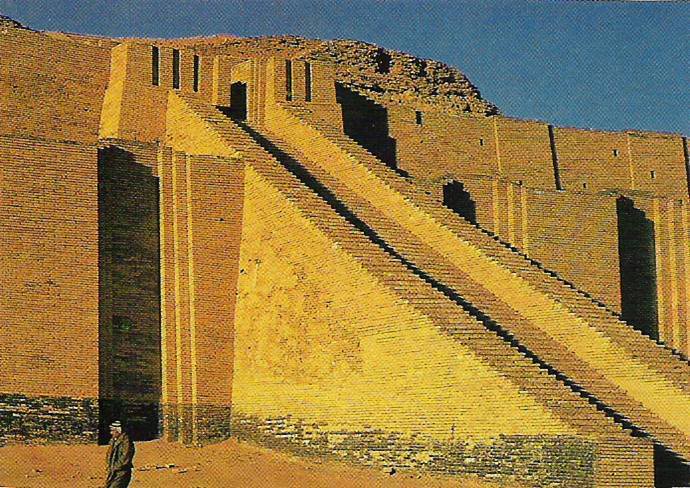
                     

     Just as Ancient Mankind copied the dress and appearance of the Anunnaki they also copied their temples. The Egyptians long before they built pyramids they built exact replicas of Sumerian Ziggurats. They were called Mastabas and like the Ziggurats they were built from clay bricks.


     The Mastabas (above) had the same tier leveling architecture, in following with the Ziggurats of Mesopotamia. The Egyptians understood the style of construction but as with the Sumerians they never understood their purpose. The Egyptians determined them to be burial sites for their Kings. The Anunnaki though had no concern for a burial site since they had the opportunity for everlasting life. The ancient cuneiform text reads;
            What you seek you shall never find.
          For when the Gods made man 
          they kept immortality for themselves.


     The unified ruler of ancient Egyptian under King Djoser in the aerial photo above, shows his pyramid with it's 7 steps at Saqqara. Pyramid temples were built near the centre of a complex indicating their importance.

     These temples were extremely important to the Anunnaki as many of their reliefs show them atop their Ziggurats. At the top to the Ziggurats was the temple centre piece, and this substantiated the existence of the Temple itself. This singular important location was what the Anunnaki called the ABZU. The meaning of Abzu is distant or deep water. Ab translates as water and Zu as distant/ deep.

      The Abzu is something more than just distant water, as this text suggest; "Abzu the pure place where the fates are determined".
      The Abzu was central to their very lives for without it, the Anunnaki would loose their longevity to their existence.
                                              {The Sumerian Abzu Blog}

     In the Sumerian tale of the Turtle and Ninurta, Enki sets an ambush at the gate of the Abzu, and traps Ninurta.
Against Ninurta, Enki fashioned a turtle from the clay of the abzu. Against him he stationed the turtle at an opening, at the gate of the abzu.

This gate is at the top of the temple Ziggurat.


     The above image shows an Anunnaki that has climbed atop the Ziggurat, (illustrated by the cone shaped objects, as if indicating the 7 tiers of the Ziggurat itself), and making entreaty to Enki seen siting at the gate of the Abzu, surrounded by water. (also illustrated as the door atop the coned Ziggurat just above the Anunnaki)

      These pyramid shaped temples were built wherever the Anunnaki resided on earth. In Egypt and in South and Central America some these magnificent structures still remain. Centuries later long after the disappearance of the Anunnaki, mankind chose to use them for their own purposes. These temples then became central to the religious beliefs of man. These temples then changed from their original purpose to become part of an after life and a venerated burial site for mankind.  To this day archaeologists believe that the Great Pyramid was built by the Old Kingdom of Egypt. A civilization that up to that point in history showed little ability to build such an empowering structure.
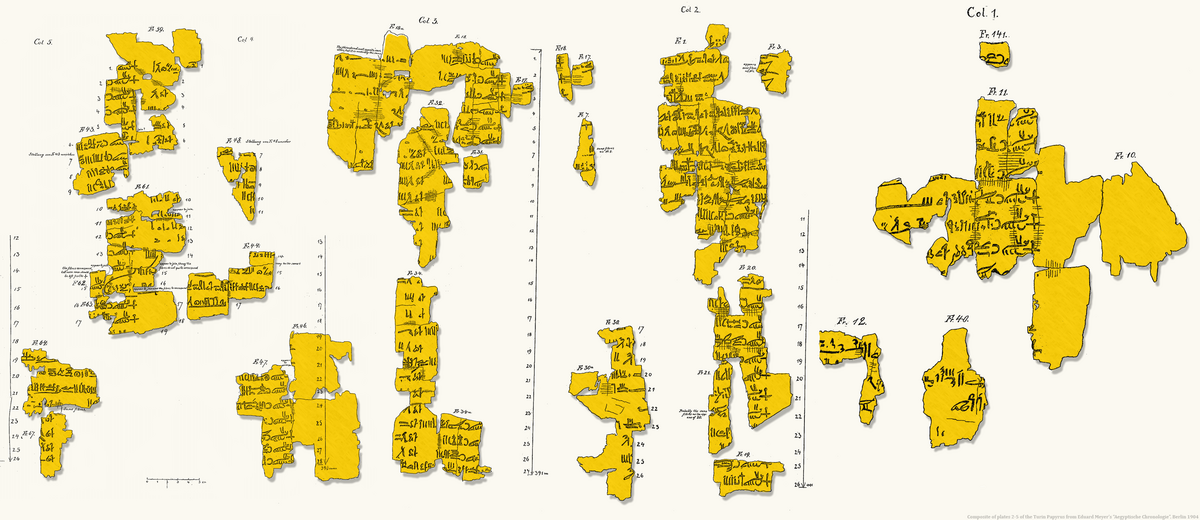

    In 1822, the Italian Egyptologist Bernardino Drovetti discovered a mysterious papyrus document near the Thebe’s necropolis. It dates back to the Dynasty, during Ramesses II reign.
This document was called the Turin Royal Canon  and speaks about  Zep tepi or the First time of Osiris.


    The main characteristic of this document is a long list of Kings of Egypt that ruled Egypt pre diluvian, before the thirty dynasties that scholars today officially approve. This gives rise to a much longer period of a sophisticated society living in Egypt, when the Great Pyramid was originally built. The sequence of the King's listed, originated some 33,000 years before the dynasty age.


What gives credence to this document is that the Sumerian King List also lists ruling Kings in the Valley of Sumer, that ruled in this pre flood era. Two unrelated documents  that both record the same history, make the history authentic. Scholars still do not accept this as history, but see this period as simple myths.

John Anthony West proposed his reasoning, absolutely worthy, when he wrote:

As if today's Egyptologists know more about ancient Egyptian history than the ancient Egyptians themselves. That is the standard height of academic arrogance

(West’s research was dating the Sphinx extensive water erosion that can be seen from atop the Sphinx)


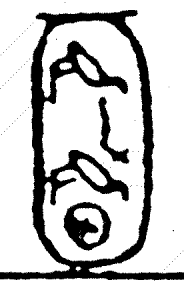
Who did build the Great pyramid? Most scholars believe that Khufu was responsible for the earth’s greatest construction feat, pointing to his cartouche in the Campbell's chamber as giving evidence.


Fig. 1 above is the existing cartouche in the Great Pyramid


Fig. 2. Below is the cartouche recorded in Vyse’s journal.


    In May 27th 1837 Col. Vyse recorded in his  journal a cartouche he discovered  in the Great Pyramid. What is bizarre about his cartouche is that it does not spell Khufu’s name correctly, Vyse’s cartouche has since been modified in a restoration to correctly spell Khufu’s name as indicated in Fig. 1 to support the belief of the builder of the Great Pyramid. This oddity is not the most unusual detail about a King recording his name on such a  magnificent structure.


The Great Pyramid has no painting, no art work, no painted drawings, no inscribed depictions and no stone cutting depicting a language or figure.

    If you were a great King of Egypt; would you send someone to misspell your name in paint which fades through time, in one of the most difficult and obscure locations in the pyramid, when the whole of the pyramid is entirely bare?

    Who painted this misspelled  cartouche?  None other than Vyse himself. He painted the cartouche of Khufu to gain for himself fame, fortune and note aridity, thus being the first to identify the builder of the Great Pyramid. If he drew the cartouche in a well known visible location in the pyramid it would have been quickly seen as a fake, but hiding the cartouche in a very difficult location would allow his fiendish plan to be accepted.


    Since then, scholars have been misled to believe that Khufu was the builder of one of the seven wonders of the world.  The normal evidence of the steps required to achieve such an imaginative process are lacking, and neither the physical construction nor the social philosophy behind it have no historical precedent in Egypt.

    Mankind may have started over several times throughout the millenniums of time that man has existed on earth. The great period of time before the diluvian epoch, gave rise to some advanced learning, which enabled the Egyptians to build great structures. The Great Pyramid and the Sphinx were both built during this time when the Gods ruled Egypt and walked among mankind.


       Many of the reliefs of the Great Gods show them having a 1/2 man half fish like appearance. In the relief above is a very common depictions showing the Anunnaki on either side of the tree of life and looking up and pointing to a chariot of the Gods. Their appearance is fish like.


                    Dagan picture below is seen as a fish god.           


      In one of the earliest known artifacts of a sculptured Anunnaki, dating around 5000 BC , the Anunnaki is wearing the horned headdress and long bread, indicating his status, but also what appears is that his skin, has a fish scale like appearance.


      Were the Anunnaki able to extend their lives as the relief seems to indicate with the help of their chariot of the Gods?

             {The Babylonian History of Mankind Included a Great Creature Named Oannes  blog}

Not just extend their lives, but change their form.

      By about 2000 BC the Anunnaki start to disappear throughout the earth. For what reason no one is sure. One suggestion is that they are losing their influence and power over mankind as man's earthly knowledge was superseding their need for the Anunnaki. They were no longer seen as Great Gods. One thing is sure is that one Anunnaki stayed on earth to influence man. That God was Dagan, the God of the Semitic people.

                                  { Dagan the First God of the Semitic People blog}

      Dagan was marooned on the earth, by Enki's  order. After the destruction of the Akkadian nation and it's great city Agade and just prior to the fall of Agade it's capital,  Enki orders all of it's treasury, of this great city, to be brought to his Abzu. Enki doesn't stop there but atop the Ziggurat at Agade the poles of the Abzu are to removed by his order, indicating that the function of the Abzu for Dagan is finished.

The text reads; “Ninurto brought the jewels of ruler ship, the royal crown, the emblem and the royal throne bestowed on Agade.”
                         "Enki tore out its well-anchored holy mooring pole from the abzu. Inana took away its weapons."
       Dagan at this point is alone, and without connection to the Abzu controlled by Enki, he is now isolated and marooned on earth. The text indicates that all the Anunnaki had turned against Dagan to destroy his Semitic seed, the Akkadians.

       Dagan then becomes the driven god of the Semitic people. To make them rulers of the Earth. His ego and lust for power seeks no end.

      The  Bible texts indicate what he has become; The God of the Semitic Akkadians had become a God of never ending “bragging”.  Isaiah 45; versus 11-21 is just one of the many examples, Job chapter 38 another. “I made the earth and I created man- I created the heavens”. There is pages upon pages of this never ending self posturing, incessant bragging. My point from all of this is; if there is a 'One God the creator”, that sees fit to come down from his heavenly place, and speak to a lowly human on earth, which can be no more than a fly speck in relation to the Universe, then why does he have to spend an inordinate amount of time bragging to this fly speck? Does he have some personal insecurity issues, or is this an attempt by Dagan/ Yehwah to support his need and human reliance and therefore vindicate his own agenda. I just cannot imagine an omnipotent God the Creator, to feel the satisfaction of man's approval, and the need to be worshiped. It sounds preposterous.

      Is there some indication that Dagan is still alive, influencing the world, or without the Abzu has he died as with all mankind?


Thursday, 13 March 2014

Numerous Financial Executives Found Dead

Are these Financial and Corporate Executive Deaths in anyway Connected.

Of first noted, is that all these deaths have been reported as suicides, which in itself is somewhat telling, and mystifying.
Secondly not one of these suicides involved the use of a gun. Take note that professional killers, rarely use guns, as today's police budgets have large amounts of funds designated on tracing bullets and guns to their owners.
Thirdly a large number of the deaths were from one brokerage firm, J.P. Morgan, and one large international insurer Swiss Re Ag. the world's second largest re-insurer.
The fourth point is that many of the deaths occurred on consecutive days. This again is very suspicious.
   Aug. 26, 2013; Pierre Wauthier found dead. An employee of Zurich Insurance Group.
   Jan. 11, David Bird goes missing. A 20 year veteran of following the commodity markets as a news reporter. Soon after he is declared missing all of his previously written articles have disappeared from the Wall Street Journal.
   Jan.26, Tim Dickerson found dead. An employee of Swiss RE Ag
Sunday, Jan. 26: William Broeksmit, a 58-year-old former senior executive at Deutsche Bank AG, was found dead in his London home after an apparent suicide by hanging.
Monday, Jan. 27: Tata Motors managing director Karl Slym died after falling from a hotel room in Bangkok where he was staying with his wife.
Tuesday, Jan. 28: 39-year-old vice president in JPMorgan's investment bank’s technology department, Gabriel Magee, died after falling from the roof of the company's European HQ in London. Police initially reported that “thousands of horrified commuters” witnessed the death. Unable to produce a single one, police are now investigating. Wall Street on Parade (Feb. 23) reported, “Friends report that Magee was a happy, healthy, vibrant young man who emailed his girlfriend on the evening of January 27 to say he...would be home shortly.”
Wednesday, January 29: 50-year-old Russell Investments’ Chief Economist Mike Dueker died from apparently jumping over a 4-foot fence and from a ramp near a Tacoma, Washington bridge. His body was not discovered for days.
The week before, a U.K.-based communications director at Swiss Re AG died. The cause of death has not been made public. (The reference is to Tim Dickensonthe circumstances of his death are still undisclosed.)
Monday, February 3: 37-year-old JP Morgan executive in Equities Trading, Ryan Crane, died suddenly in his Stamford, Connecticut, home. The state’s chief medical examiner is determining the cause. When Wall Street On Parade called the Stamford Police to ask for the police incident report to which the press is legally entitled under Connecticut law, it was told “if we were able to obtain the incident report, most information would likely be redacted.”
Tuesday, February 18: 33-year old JP Morgan forex trader Li Junjie is the latest in a string of suicides to take his life in Hong Kong. No suicide note was found. Two days before his suicide, Junjie spoke of plans to return to Toronto, where he had worked at the Royal Bank of Canada.
Other names could be added to the Financial Post list:
December 15, 2013: 34-year-old JP Morgan employee in Client Technology Service Jason Alan Salais died in Texas of an apparent heart attack. According to the National Center for Health Statistics, the rate of heart attacks among men aged 20 to 39 is one half of one percent of the population.
February 4, 2014: 57-year-old founder and CEO of American Title Service Richard Talley died after apparently shooting himself with a nail gun. The Denver Post (Feb. 10) stated that he had shot himself seven or eight times in the head and chest. Talley and his company were being investigated by state insurance regulators at the time.

Death scene below in Hong Kong. A JP Morgan trader, apparently jumps to his death.


     A puzzling point to all these deaths is that why would someone of a high degree of education and sophistication, commit suicide by jumping off a bridge or out of a office building? In one case the executive transferred $800 million dollars to family members weeks before his death. Why would these people be afraid of the court system, if they were fearing some legal action, when they had the funds to hire the best of lawyers with just a phone call away?

     In one case the victim shot himself numerous times with a automatic nail gun. Does this sound like suicide or a form of torture?

     What information or knowledge did these victims have that was so dangerous and valuable. Is there more deaths that have yet to be uncovered? An example is the Boeing 777 airline that just went down. A number of fraudulent passports were later discovered as passengers on that flight. Were these J.P. Morgan forex traders trying desperately to cover their tracks that needed to be eliminated?

What connection is there between J.P.Morgan and Swiss Re Ag.


    J.P. Morgan's European headquarters at Canary Wharf London.

      The first death was Pierre Wauthier, an employee of Zurich Insurance. A suicide note was found, but it was typed. 
A typed suicide note is extremely rare. Suicide is a very emotional point in one's life, and to turn on the computer, then type a note, then plug in the printer, then hit print on the computer doesn't very often happen.

      Prior to being employed at Zurich, Wauthier worked for J.P. Morgan for 11 years, as V.P. of Insurance Product Group. J. P. Morgan is the market maker in the Zurich Group, giving different weight analysis to different stocks and their performances.  A very important position of authority. J.P. Morgan is also the investment bank for Zurich, and also is the asset manager for a number of funds offered by Zurich Insurance Group.
     After the death of Wauthier, Zurich Group announced the appointment of G. Quinn to replace Wauthier. G. Quinn was formerly from the Swiss Re Ag Insurer.
     Swiss Re Ag has had a long history with J. P. Morgan. In Jan 2010, Swiss Re obtained a $1 billion Letter of Credit from J.P. Morgan, and also served as Swiss Re's investment bank on many deals. In return Swiss Re and Zurich Group provided J.P. Morgan with liability insurance, which they seemed to need on a regular bases.
     For several years US regulators have been trying to make sense on how J.P. Morgan Luxembourg S.A. was doing in it's "Whale Trades", that has lost $6.2 billion using depository money at FDIC insured banks.
     According to an online analysis at Zurich Insurance Group’s web site, one JP Morgan's managed funds, the Global Natural Resources Fund, has lost 42.54 percent as of June 30, 2013, reflecting its performance since inception on April 2, 2012.
     These 3 firms have been in several significant financial arrangement, some of which have brought fraud charges that resulted in out of court settlements.

What information would be so valuable that results in murder?

    This information is the end game, survival of the world's elite wealthy class, that feel they have a sense of entitlement. This is the 1%  of the world's population that controls 90% of the world's wealth and have no intention of falling into the madding crowd.

      World currencies are about to be reset, to better reflect a countries wealth and debt ratio. This has extreme ramifications for the US dollar. As years of excess by America's once envied and coveted middle class, has resulted in their eventual commonality. This commonality will now be found in the form of a new universal working class. The US dollar is about to be devalued by 50%, while rising economies with positive current accounts will have their currencies move higher. This is Obama's grand plan of a common level playing field that the world is now demanding.

      America's new working class will find the drudgery of daily living, as merely endless moments of cogs turning in a machine of wheels.  Dreams of an idyllic future, and an endless supply of cheap consumer goods paid for by easy credit will now be covered by the devil's cloak. America's drug culture will be embraced by the legalizing of drugs to soften the impact of reality as America's new working class grapples with the prospects. 

              How will the elite survive with their wealth?
    With the resetting of the US dollar, wealth has to be preserved in as asset that is not fixed to the dollar. The answer for this is purchasing real assets not based in America, and these assets are base metals. Base metals, Copper, Nickel, Zinc and Aluminium, are the building blocks of industry, and can be purchased as real assets, not as a future contract, or an derivative or an option, but as a real asset. If market conditions become extreme these type of paper contracts may not be worth the paper they're written on.
    The London Metal Exchange, (LME) has been central to the base metal industry. LME gives out interest free loans to their select customers and arranges storage for their metals. How LME makes most of their money, other than transaction fees, is on extremely high storage fees? LME then has statistical data, on the amounts of base metals in storage, and pricing of these metals. To have this continual knowledge of a metals complete supply, and price is a great advantage in positioning your market plays.

     These high storage fees eliminate contagio. A market condition when the future price is always higher than the existing price. A conditions that almost guarantees a continued line of profits. This is a manipulated market condition that existed a few years ago with oil pricing, when oil went over $150/barrel. Goldman Sachs was one of the major contributors to this market condition.


   The London Metal Exchange

  A number of international investment banks and large trading firms, have come up with a brand new plan.

Glencore a major Swiss trading firm, using it's metal warehouse company, Pacorini. Pacorini now is in control of 60% of the world's Zinc supply, and is warehousing it in difficult and rather unattainable locations.Their warehousing costs are far less than LME which creates an example for a market condition known as Contagio to occur.
Goldman Sachs, a NY Investment Bank, using it's metal warehouse company, Metro. GS and J.P. Morgan have entered into a warehousing agreement for base metals.  
J. P. Morgan a NY Investment Bank, using it's metal warehouse company, Henry Bath
Both of these US Banks are now under overview by US regulators in what is seen a market manipulation, and both may be forced to sell their US interests in metal warehousing, but at the same time expand outside of the US. This in effect pushes the markets outside of the US dollar, as a major number of trades are now in Swiss Francs.
Julius Baer, a Swiss Investment Bank, and Credit Suisse have recently teamed up to warehouse copper and Zinc, using their own warehouses rents at much reduced costs than LME. 


Metal warehouse.

    The elite 1% will survive, while the world's currencies and markets are in turmoil, and come out the other side even more rich than before.

     A new world awakens, a world I hope that I may not have to endure. A world of 2 classes of people. Those that hold the dreams and those that only can wish for them.

The Gold Connection

This article outlines why the US dollar has to be revalued lower, and a possible reason for the aforementioned deaths.


Why Germany Wants its Gold Back


After spending more than 50 years in foreign hands, Germany's gold is finally going home.
In a recent watershed decision the Bundesbank, Germany's central bank, has decided at least half of its gold should be held in its own vaults.
Since the Bundesbank is the second-largest gold holder in the world, that's going to mean moving 54,000 bars of the shiny metal.
Gold
So why does Germany want its gold back, and why now?
Part of it has to do with pressure from a grassroots group led by a group of economists, business executives, and lawyers, along with the German Precious Metals Association, who have put together a "Repatriate our Gold!" campaign.
But that's only part of the story...

Official pressure began last October when the German Federal Court of Auditors requested an inspection of the gold Germany stores in foreign central banks.
That sparked something of a political controversy since these gold reserves have never been thoroughly inspected and audited.
What's more, the U.S. Federal Reserve had already refused to allow the Germans to verify their gold despite several attempts.
According to Der Spiegel:
"Finally, in 2007, "following numerous enquiries," Bundesbank staff members were allowed to see the facility, but they reportedly only made it to the anteroom of the German reserves.
In fact, auditors from the Bundesbank made a second visit in May 2011. This time one of the nine compartments was also opened, in which the German gold bars are densely stacked. A few were pulled out and weighed. But this part of the report has been blacked out - out of consideration for the Federal Reserve Bank of New York.
So why would the Federal Reserve deny the Bundesbank a full inspection and audit?
That question has been rich feed for the rumor mills ever since the news broke.
So let's have a closer look at the surrounding facts...

The Significance of the German Gold Repatriation

According to the plan, Germany's gold repatriation will take seven years to complete and by 2020, Germany will store 50% of its gold in Frankfurt. Several analysts consider that, since the gold will only be moving from one vault to another, this transfer will have no measurable market effect.
But I think it's a mistake to make that assumption. Instead, this news could have a significant psychological impact.
Here's why...
Others will follow Germany's lead. The Dutch are already making similar noises, asking for an audit and full transparency. The Netherlands also only has 10% of their gold reserves at home, with the rest in New York, Ottawa, and London. Now it's only a matter of time before others start to ask the same kinds of questions. In a recent tweet, Bill Gross said what many are probably already thinking: central banks just don't trust each other anymore.
Growing concerns about the euro. There are suggestions Germany wants its gold because it's worried its loans to less fiscally responsible sovereigns won't be repaid. But I believe Germany is preparing in case the Euro were to eventually dissolve, so it wants its gold to potentially back a new Deutsche Mark. Perhaps they, too, recognize gold's return to its role as money.
A list of unanswered questions. The first is obvious: Is the gold really there? If so, why would it take seven years for Germany to get its gold back? Would you take the risk of collecting it slowly, or would you want it much faster? Some say the gold's there, yet others disagree. Steve Scacalossi, vice president and director, global precious metals at TD Securities, says Germany's gold is allocated, and therefore can't be lent out, so it will not affect gold lease rates.
Meanwhile, Keith Barron, a geologist and consultant responsible for one of the largest gold discoveries in 25 years, recently told King World News:
"I believe that most of the Western world's gold, which is supposed to be in central bank vaults, has been leased out. Much of it is now in private hands in India, and what remains continues going East to China and other Asian vaults. So most of the Western gold has vanished from the vaults and it's now just a book entry. These various Western countries and bullion banks simply roll these leases over when they come due, and the gold never gets returned back to the countries. So it's very interesting to see what's going on. Obviously the trust is breaking down in the system."
While some could easily dismiss Germany's behavior as that of a distrustful state, there's precedent for Barron's claims.

The Story Behind Portugal's Lost Gold

In 1990 Drexel Burnham Lambert, one of America's largest investment banks, filed for bankruptcy. Drexel's failure is famously blamed on junk bond trader Michael Milken.
But few know that the central bank of Portugal had loaned 17 tons of gold to Drexel. When the firm failed, Portugal's claim on its gold simply evaporated.
That was more than two decades ago at a time when almost no one was interested in gold, which then traded at $380.
Today, gold sells for $1,660 per ounce, and now a lot more people are paying attention.
The fact is, if Germany's gold is really sitting in the vaults of the New York Fed and the Banque de France, it shouldn't take until 2020 for it to make its way back home.
Seven months -- maybe. Seven years means something else is up, and that raises suspicion.
Such a delay makes you wonder if these central banks aren't being forced to "buy back" the gold they may have leased out.
Anthem Blanchard, CEO of Nevada-based Blanchard Vault, a precious metals storage company, appears to agree with PIMCO's Bill Gross.
Mr. Blanchard recently told Canada's Globe and Mail, "most importantly, the action of repatriation signifies the acknowledgement of credit risk and the Bund's [Bundesbank's] concern of any possibility that gold held at the Fed may be over-pledged in some manner."
Meanwhile, the physical gold market is one that many already consider to be rather tight.
If Germany calling in its gold unleashes a run by other nations on central-bank-stored gold, the physical market could react with a massive squeeze.
That's in addition to the fact central banks are stepping up their gold acquisitions. As a group, they bought more gold in 2012 than at any time in almost 50 years.
Now it's entirely possible that fear's been struck in the hearts of central bankers around the world.
That means the price of gold could skyrocket, putting downward pressure on the US dollar.

Before this to happen it is very possible the US will put downward pressure on all commodities, which will result in Gold dropping, therefore allowing the US to buy back gold at a much more affordable price. A price it initially sold this foreign Gold for.
For investors, the lesson is simple: Learn from Portugal's failure.
Be like Germany, and get yourself some physical gold.


Friday, 21 February 2014

Entropy and the Universe


                               Entropy and the Universe


Milky Way over Devil's Tower

     Entropy is defined as the lack of order of predictability or the degree of randomness of a system. Over time all states as in temperature, pressure, and chemical potential will end in a state of thermodynamic equilibrium. This is called the second Law of Thermodynamics.

     The entropy of the Universe continues to the maximum, as it rises over time. Time being measured in the billions of years. As entropy rises, the perception is that the amount of free energy and matter will diminish and will be unavailable for the entropy values to increase.

     Hence a paradox arises. As work can no longer be done, then life as we know it may ceases to exist. At this point the Universe itself would cease to exist? This of course furthers the question of whether the Universe is an open system, and is the Universe in a state of equilibrium?

     The equation of entropy for the Universe is;

       \frac{dS}{dt} = \dot S_{i} with   \dot S_{i} \ge 0

S is the entropy
t is time
Si is the sum of the rate of production of entropy

     To plot a curve for the values of entropy and time a starting point is necessary, which brings into question whether entropy and time have a beginning, as in a Zero value. I have always contended that there has always been time and space in the Universe, so for lack of argument sake, the following will be that both values of entropy and time will approach zero.

     The curve for time v.s entropy with time being the "x" axis


Figure 1
This exponential curve illustrates entropy values increase over time, measured in billions of years. As entropy values increases, time over this period slows. This then follows with the entropy curve, depicted below.


                                   Image result for exponential curve      

Figure 2
     In the exponential curve above which is depicting the values of entropy as the "y" axis over time in the "x" axis, entropy increases in values until a point in the future where it's rate of incremental change slows, as the Universe's free matter and energy falls. This is what one would predict.

     Both graphs predict that over time, both entropy and time approach zero.

     Why would time slow as entropy values increase? Time slows to enable the curve in figure 2 to never approach zero This would mean that the rate of change of entropy throughout the course of time would remain more constant.

     Time is also slowed, so the rising entropy values will continue, and are not predetermined by falling free energy and matter values in the Universe.

      The most important explanation for time slowing is that it enables the thermodynamic state of the Universe to be close to a state of equilibrium from the Second Law of Thermodynamics. This state of equilibrium allows the Universe to exist forever. The Universe existing forever is a common believe that all of us hold.

Theorem;

The universe has existed and will exist forever:
Therefore time must slow


Friday, 6 December 2013

The Great Sphinx of Egypt


                                                           The Great Sphinx


    One of the Egypt's national wonders, and one of the greatest wonders of the world, is the Sphinx. It remains the world's largest stone figure since it's creation. The Sphinx is 73 metres long, 20 metres high and 19 metre wide. It was curved out of a solid piece of limestone outcropping. This limestone has an interesting geology, and that it's hardness changes as elevation changes.

      It has been considered by many to be built during the Old Kingdom of Egypt, but there is no inscription or record as to who built  the Sphinx or the date of it's construction. Any suggestion to the origin of the Sphinx , can only be based on circumstantial evidence.

     The date of it's construction can be considerable older than many have theorized. In 1858 a limestone stela (Inventory Stela)that was recorded by KHUFU states very clearly that this early 4th Dynasty King of Egypt ordered the Sphinx was to be restored. Not to be built but to be restored.   This dates the construction of the Sphinx to be much older than previously thought. It states that KHUFU found the buried Temple of ISIS, and then restore it. "built the temple of Isis anew". The Giza Plateau seems to be an important restoration period in the 4th Dynasty.

      This of course is all denied by modern historians. 

     The ancient Egyptians never called the Sphinx by that name, in fact no name was attached to the Sphinx until the New Kingdom. It was then called "Horus of the Horizon" possible due to the Sphinx looking directly east towards the Horizon, as if waiting for the Sun to rise. This name can be verified by a stele found at the foot of the Sphinx, that is often refereed to as the "dream stele". In the writings from the "dream stela", a young prince falls asleep under the Great Sphinx, after taking a walk. He then has a dream in which the God of the Sphinx promises to make him King if he digs him out of the sand. The young prince then digs out the Sphinx uncovering it's paws and  then places a stele at the feet of the Great statue to remember the event.

      In fact the Great Sphinx was buried to it's neck for most of it's existence. It wasn't until 1936 that the statue was completely uncovered, by an explorer Emile Baraize. There is evidence to support that after King Cambyses and  the Persians in 525 BC  conquered Egypt, that the Sphinx would have fallen into neglect until uncovered in 1936. Many now question the massive amounts of erosion on the body of the Sphinx, when for the most part of the Sphinx's existence, it was buried. Would this not indicate a far older Sphinx than previously thought?


Photo from the early 1870's, some excavations were done.

                                Was the Sphinx a Lion

      The word, 'Sphinx" is from Greek mythology, not Egyptian, and  the statue only assumed this name in modern times.  The Egyptians made NO mention that this huge monolithic structure was even a lion, or any animal for that matter. The idea that the Sphinx was a Lion was strictly a modern vision of the figure.

      In ancient Egyptian's mythology, the Egyptians had a lion goddess named Sekhmet. Sekhmet had the body of a woman and the head of a lion. She was a warrior goddess. On top of her headdress was a solar disk.

                                             Image result for sekhmet goddess


                                             Image result for Ammut


       The other Lion goddess of the Egyptians was Ammut. Ammut had the head of a crocodile and the body of a lion and hippopotamus, illustrated above.


        Neither of these two Lion goddess's seem in any way related to the Sphinx.

How did the Egyptians represent Lions in their reliefs and mythological art?


    Noted above are three forms that the Egyptians depicted Lions in their art. The only art form that closely resembles the Spinx is the first one. Please note that all these lions have NO necks. There heads are attached almost to their shoulders as in nature. The first Lion pose in a laying position is very rare in ancient Egyptian art. Almost all are more related to the side pose,(2nd fig.) which again is true to nature.

  Now compare that to the Sphinx.


    The above picture of the Sphinx shows a well defined neck. A neck that held the head of the Sphinx completely upright and erect. In the Egyptian depiction of the Lion, the Lion's head is straight ahead of the shoulders, and does not sit upright, which is contrary to the Sphinx.

    So the question is what is the Sphinx, and what did it represent to the Egyptians?

    Anubis, the Jackal God of the Egyptians, was one of the most important and well documented Gods of the Egyptians. He was depicted in almost every scene in Egyptian reliefs and paintings. The High Priest would wear his headdress, that depicted the jackal, on certain occasions.

    Anubis was first mentioned in the Old Kingdom on the pyramid text, as he was closely associated with the burial of the Kings of Egypt. Anubis is the protector of the dead and their mummification. Anubis was the protector of the dead on their journey into after life. Anubis then fits perfectly into the surrounding architecture of the area. The three pyramids. He's protecting the dead Kings of Egypt on their journey into afterlife.

     Noted below how Anubis is depicted in Egyptian art form.  


Anubis is always depicted in this laying state. Notice that Anubis has a neck that holds the head of the jackal upright exactly like the Sphinx. In his human form only his head is shown.

     Now why would the "dream stele", call the Sphinx " Horus of the Horizon". Anubis and Horus were 1/2 brothers, and later in Egyptian mythology these two Gods were joined and eventually Anubis is replaced by Horus. This was possibly done as a political move by the priests. It is therefore understandable that the "dream stele" would name the Sphinx, Horus of the Horizon.

     The most intriguing question is now what happened to the head of the Jackal of Anubis? It would seem that as the importance of Anubis diminished it led to a new King of Egypt to super impose his facial image on the body of the Jackal. It would appear that this King came from the Middle Kingdom.

     A German Archaeologist, Ludwig Barchardt, prior to the excavation of the Sphinx, was able to stand in front of the Sphinx's head and do an in-depth study. He determined by the style of how the eyes were painted in a stylized stripes, that the Sphinx's head had to be from the Middle Kingdom. He also noted the stripe patterns of the headdress worn by the Sphinx. This was only worn by a King of Egypt, and this King could only be from the middle kingdom. The pattern of stripes on the Headdress defined the period which that King reigned.

      We  know the Sphinx was much older than the Egyptian Middle Kingdom, so this all lends itself to the theory that a King from the Middle Kingdom, did a massive amount of architectural renovation on the head of the Sphinx. Who was this King?? There is the usual suspects.

     The most likely to fit the suspect list would be Amenemhat 2. Amenemhat 2 was the third King of the Middle Kingdom. There is two very convincing arguments that point to this King in the Middle Kingdom to have carved his image on the face of the Sphinx.

1st. There is an actual Sphinx carved from pink granite that has been found with Amenemhat 2 name inscribed in it. This Sphinx now resides in the Louvre in Paris. This art form, became more popular years later following the 18th dynasty.


     Take note that the body of the statue is actually a Lion, and it has NO neck. The head is attached directly forward of the shoulders. This would lend itself to believe that after Amenemhat 2 had this statue commissioned, he later got the idea to transform the Great Sphinx, using a similar design. A grander scale of the same image.

2nd. The image itself resembles the Sphinx's facial features.


     Notice the overly large size of the eyes and the expression on the mouth, and the size of the nose. (Refer back to the above image) It's almost an enlarged baby face.  These features are almost identical to the features on the Sphinx.

     This all points to the fact that our preconceived ideas of the Sphinx were wrong.